
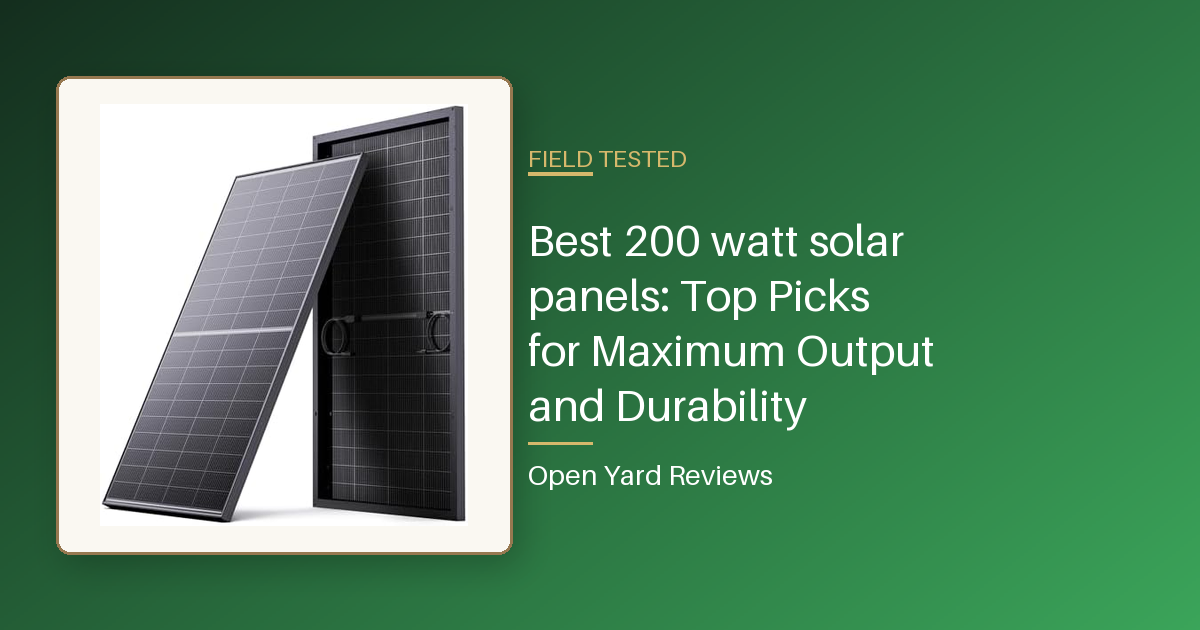
Choosing the right 200 watt solar panel can make the difference between a reliable power source and wasted sunlight. For RV owners, off-grid cabins, or anyone building a portable kit, panel efficiency and real-world performance matter more than brand hype.
This guide focuses on panels that deliver close to their rated output, hold up to weather, and fit the needs of buyers powering everything from fridges to laptops. Each pick is based on how well it handles shade, mounting, and day-to-day reliability.
All panels here are proven performers, but one rises above for buyers who demand maximum efficiency and output, especially in tough conditions. If you need a portable option or want to stretch your budget, there are strong alternatives.
Scan the key takeaways, check the comparison, and use the buying guide to avoid common mistakes. The FAQs answer the real questions buyers ask before spending hard-earned money.
The short version: Callsun’s N-Type 16BB 200W bifacial solar panel is the clear winner, thanks to its unmatched output in partial shade and ability to exceed rated power with smart setup. Renogy’s 200W portable panel is the best runner-up for buyers who need a lightweight, foldable option for camping or quick setups.
Our overall best pick: N-Type 16BB 200W Bifacial Solar Panel →
| Product | Efficiency | Weight | Dimensions | Waterproof Rating | |
|---|---|---|---|---|---|
| N-Type 16BB 200W Bifacial Solar Panel | 25.6% | 23.8 lbs | 51.3 x 30.3 x 1.4 in | IP68 | See on Amazon |
| Renogy 200W Portable Solar Panel for Power Stations | 25% | 13.89 lbs | 23.72 x 22.99 x 1.97 in | IP65 | See on Amazon |
| HQST 200W Solar Panel, N-Type, | 25.4% | 20.17 lbs | 30.1 x 46.3 x 1.2 in | IP65 | See on Amazon |
| Renogy ShadowFlux Solar Panel 200 Watt | 25% | Unlisted | Unlisted, smaller than standard PERC | IP67 | See on Amazon |
| 200 Watt Solar Panel 18BB | 25% | Unlisted | Unlisted | IP68 | See on Amazon |
N-Type 16BB 200W Bifacial Solar Panel
The Callsun panel’s dual-module parallel design keeps power flowing even when one side is shaded, making it ideal for RVs parked under trees or with roof obstructions. Real-world use shows consistent output above 200W: one owner measured 245W in winter, another saw an extra 84W per panel on a 20-degree tilt metal roof.
Switching from traditional panels, buyers find the bifacial rear-side capture delivers up to 50% more power in indirect light, and the panel reliably charges lithium iron batteries and power stations. Build quality is solid, with a strong frame and tempered glass that ships well and survives typical handling.
Pre-drilled holes make mounting fast, and the 23-pound weight is manageable for rooftop installs. The panel’s low temperature coefficient (-0.3%/K) ensures stable output in high heat, and the IP68 junction box means no worries about rain or dust.
Even when partially shaded, the TwinCell layout prevents full output loss, a major advantage for mobile setups. A few panels arrive underperforming (down to 63W), but the manufacturer replaces faulty units promptly.
Some corner protectors break easily, but the panel itself stands up to regular use. If you’re upgrading a van or fifth wheel, or want more wattage from less roof, this Callsun bifacial panel is the best buy for shaded or tight installs.
Holds up
- Bifacial tech boosts output up to 50% in indirect light
- TwinCell anti-shade keeps power flowing when partially covered
- Consistently delivers 200-245W in real use
- Solid build quality and strong glass
- IP68 junction box, reliable in harsh weather
- Manufacturer replaces defective panels hassle-free
Watch for
- Some units arrive underperforming, require replacement
- Corner protectors are fragile
- A few buyers report inconsistent part numbers/specs
Renogy 200W Portable Solar Panel for Power Stations
The magnetic handle and quadfold design make this panel quick to set up, easy to reposition, and compact enough to stow in tight spaces. At 13.89 pounds, it’s the lightest 200W option around, and the slim 24×23-inch profile suits SUVs, campers, and truck beds without crowding.
Setup takes seconds, no fiddling with snaps or Velcro, and the magnetic closure actually stays put. Charging performance stands out: reports show up to 90% efficiency on sunny days, with 155-181 watts even in scattered or early morning light, and steady output with both EcoFlow and Anker stations.
USB-C and dual USB-A ports cover direct charging for phones and laptops, while MC4 handles battery and power station connections without fuss. Build quality earns praise for feeling solid, not flimsy, and the IP65 rating means dust and splashes aren’t a concern.
The panel stays stable thanks to adjustable kickstands, though the legs can be finicky in strong wind. Users consistently mention charging a laptop, camera, and large power bank simultaneously, making it reliable for multi-device trips.
Output remains strong in overcast, though that’s expectedly reduced; the panel still performs better than most rivals in cloudy conditions. The accessory pouch holds connectors, but lacks a true travel bag, the only real knock on portability.
Not every user hits 200W: some report peak readings as low as 65-93W even after troubleshooting, especially with non-optimal setups or extension cables. The kickstand legs can be “janky” and are prone to trouble if winds pick up.
No included cables means you’ll need to match your connectors or buy extras. Still, the panel’s efficiency and easy deployment make it a standout for campers, van lifers, and anyone needing portable power on the go.
Holds up
- Delivers up to 90% efficiency (180W+ in sun)
- Weighs just 13.89 lbs, lightest in class
- Magnetic handle, foldable and compact for storage
- Charges power stations and batteries reliably
- USB-C and USB-A ports for direct device charging
- IP65 dust and splash resistance
Watch for
- Kickstand legs are flimsy in wind
- No included cables, must buy extra for some setups
- Some panels never reach full rated output
HQST 200W Solar Panel, N-Type,
This panel’s bifacial design captures extra sunlight from the rear, boosting real-world wattage above rated output when mounted on reflective surfaces. Reports show over 100 watts from a 100W panel, and the 200W version reliably powers battery banks and runs garden lighting for longer, even after cloudy days.
Its compact footprint (30×46 inches) and light 20-pound frame suit RV and van rooftops, reducing mounts and cable clutter. Installation is straightforward, but the short 24-27 inch connecting cable can complicate series setups, an extender is almost mandatory if you’re running more than one panel.
Durability is proven: panels survive ladder drops and wind flings without cracking, and the corrosion-resistant aluminum frame holds up to 2400 Pa wind and 5400 Pa snow loads. The panel performs better in low light thanks to N-Type cell tech, keeping power flowing on overcast days and in morning or evening sun.
Owners running three panels achieve a combined 10 amps easily, and mounting is secure with pre-drilled holes. The black finish is a minor bonus for aesthetics, especially on van roofs.
Drawbacks include the connecting cable length and junction box location, both of which can make series wiring a headache. Packaging is sometimes minimal, risking damage in transit, but performance is consistently strong.
If you need reliable output, bifacial gains, and a panel that shrugs off abuse, HQST is a safe bet for RVs, tiny houses, and solar upgrades.
Holds up
- Bifacial design increases output (up to 30% boost)
- Very durable, survives drops and wind
- Compact and lightweight (20.17 lbs)
- N-Type cells give better low-light performance
- Easy installation with pre-drilled holes
- Works well in parallel or single setups
Watch for
- Short connecting cable (24-27 inches)
- Junction box location complicates series wiring
- Packaging can be minimal, risking shipping damage
Renogy ShadowFlux Solar Panel 200 Watt
ShadowFlux anti-shading tech makes this panel excel where others falter: leaves, AC units, or tree shadow only cut output from the affected section, not the whole panel. Actual installs show these panels maintaining steady production on busy RV roofs, and bypass diodes prevent hot spots that ruin arrays.
Buyers running four panels hit 730W combined on clear days, with series/parallel wiring maximizing output. The panel is compact and light, fitting crowded roofs without sacrificing output.
Build is sturdy and water-resistant (IP67 rating), surviving snow, rain, and hail. Owners running off-grid camera systems report stable voltage and healthy battery float even in North Dakota winters.
Output matches and often exceeds rated 200W in good sunlight, with some panels peaking above spec. One owner ran a ham radio, heater, and vent fan off a single setup, with the controller staying in float most of the time.
Drawbacks: some panels underperform (never breaking 100W in full sun) and warranty returns require saving shipping boxes. A few buyers note inconsistent output across multiple panels, but most report stable, reliable performance.
This panel is best for RVers, trailer owners, and anyone needing power in mixed or shaded conditions.
Holds up
- ShadowFlux tech prevents total output loss in partial shade
- Compact and lightweight for crowded roofs
- Consistent output, often above rated wattage
- Sturdy build, IP67 waterproofing
- Bypass diodes reduce hot-spot risk
- 25-year output warranty
Watch for
- Warranty returns require original shipping box
- Some panels underperform in full sun
- Inconsistent output across multiple units in rare cases
200 Watt Solar Panel 18BB
This panel’s 18-busbar N-Type cell tech improves conversion efficiency and holds up well in real-world conditions: buyers report steady output through haze, clouds, and harsh winter cold. After six months of use, performance remains consistent, and overpaneling for cheap is a major draw.
Buyers running two panels see up to 175W in full sun, and those with larger arrays (10 panels) enjoy reliable battery charging even on cloudy days. Installation is quick with pre-drilled holes and compatibility across brackets.
The panel withstands wind (2400 Pa) and snow (5400 Pa), and the IP68 rating means rain and dust are no issue. One connector quality is poor, the negative side connectors come off easily, needing replacement or reinforcement.
Some panels ship with different part numbers/specs, which complicates system expansion. Corner protectors break easily, and output is sometimes lower than rated, but the price-per-watt and performance in low light make this panel a top choice for budget bulk installs.
If you need affordable, scalable power for RVs, patios, or off-grid systems, RVPOZWER is a solid pick.
Holds up
- Performs well in low light, haze, and winter
- Easy to install with pre-drilled holes
- Budget-friendly price per watt
- IP68 waterproof and durable frame
- Consistent output after months of use
- Readily available for bulk install
Watch for
- Negative side connectors are fragile
- Corner protectors break easily
- Panels sometimes ship with mismatched specs
1.True output (watts in real conditions)
Panel ratings aren’t always what you get. Look for panels that deliver close to or above 200 watts in actual sunlight, not just lab conditions. Panels that outperform their rating with bifacial designs or smart mounting are worth the extra cost. Avoid panels that drop below 180W in real use, those waste space and money.
2.Efficiency and cell type
High efficiency (over 24 percent) means more power from the same footprint. N-Type and bifacial designs boost output, especially in variable light. Don’t settle for older panels with lower efficiency unless price is the priority. A common mistake is ignoring cell type, which affects performance under cloud or shade.
3.Durability and weather resistance
Panels need to survive hail, rain, and temperature swings. IP65 or higher means decent waterproofing. Aluminum frames and tough glass are non-negotiable for anything mounted outside. Avoid panels with flimsy build or poor sealing, they fail fastest in real-world conditions.
4.Portability and mounting flexibility
If you’re moving the panel often, weight and foldability matter. Portable panels lose some efficiency but win on convenience. Fixed panels suit RVs and cabins. Don’t buy a rigid panel for camping unless you’re ready to handle extra bulk, many regret the hassle.
5.Shade tolerance and bifacial design
Panels that handle partial shade or use both sides (bifacial) deliver more power where others drop off. Shade tolerance is critical for RVs and rooftops with vents or rails. Don’t ignore the rear-side output, it can mean the difference between keeping your fridge on or not.